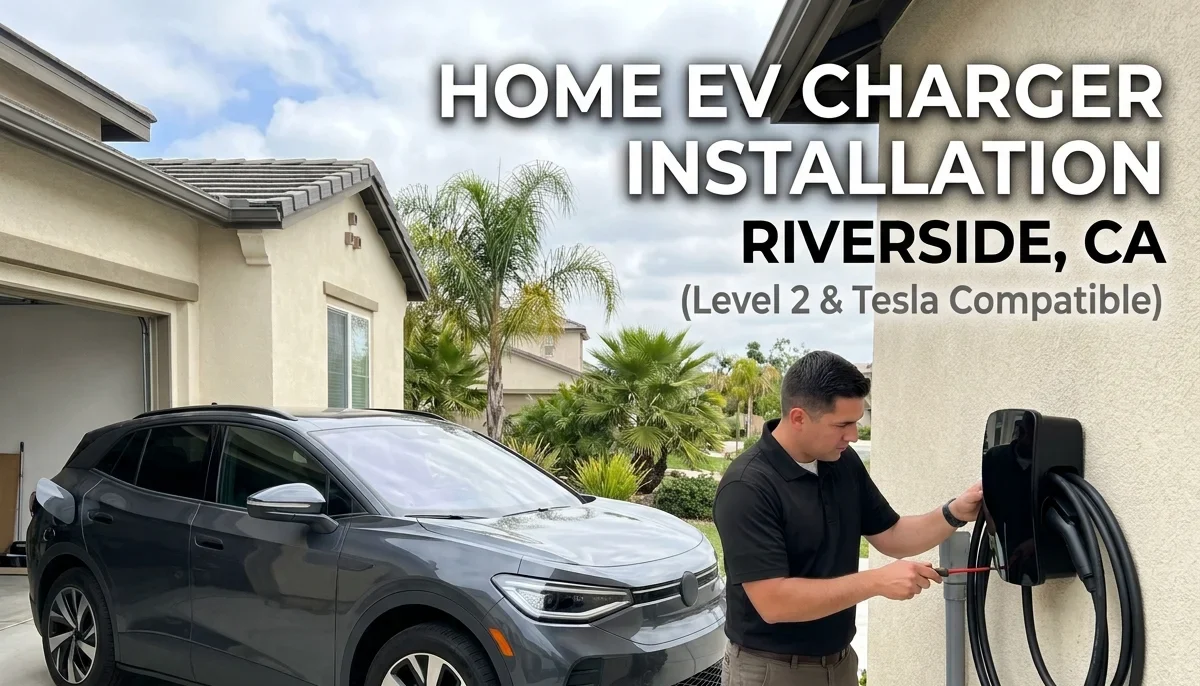
Electric cars are everywhere in Riverside now. Teslas. Chevy Bolts. Rivians. Hyundai Ioniq. If you own one, you know charging at home is way better than waiting at a public station. But installing a home EV charger isn’t simple. You can’t just plug it into a regular outlet.
Most EV owners need a Level 2 charger. That’s a 240-volt system that charges way faster than a standard outlet. Installing one means running new wiring from your electrical panel to your garage. It means getting a permit. It means having the city inspect the work. It sounds complicated. It is. But a licensed electrician handles all of it. This guide explains what you need to know about EV charger installation in Riverside. From cost to permits to how long it takes. Explore our EV charger installation services for help with charger selection, dedicated circuits, permits, inspections, and code-compliant setup.
What Is a Home EV Charger?
An EV charger is a device that supplies power to your electric car. There are different types. Understanding them helps you pick the right one.
Level 1 Charging
Level 1 uses a standard 120-volt outlet. The one in your garage right now. You can charge your car using a basic cord that comes with most vehicles.
The problem? It’s slow. A Level 1 charger adds about 2 to 5 miles of range per hour. If your battery is completely dead, it’ll take 24+ hours to fully charge.
Level 1 works for people who drive short distances. If you commute 20 miles each way, you might be okay. But if you drive farther, you’ll hate it.
Level 2 Charging
Level 2 uses a 240-volt circuit. Way more power than standard outlets. A Level 2 charger adds about 25 to 30 miles of range per hour.
That means you can charge overnight and wake up with a full battery. Perfect for daily driving. This is what most Riverside homeowners need.
Level 2 chargers cost $400 to $800 for the unit. Installation adds another $400 to $1,200 depending on your setup.
Level 3 DC Fast Charging
Level 3 is commercial. It’s what Tesla Superchargers use. It charges in 20 to 30 minutes. But it’s expensive. Residential installation isn’t practical. You’ll only see these at charging stations or commercial locations.
For home use, Level 2 is the way to go.
Why Install a Home EV Charger in Riverside?
Charging at home beats public charging stations. Here’s why.
It’s Convenient
Wake up every morning with a full battery. No trips to charging stations. No waiting. You charge while you sleep. Simple.
It’s Cheaper
Home electricity is cheaper than paying per kilowatt-hour at public stations. You’ll save money every month.
You Control It
Your charger is yours. You set the schedule. You choose when to charge. It’s on your terms.
It Adds Home Value
Buyers love homes with EV chargers. It shows the home is modern. It’s a selling point. Many buyers are shopping specifically for homes with chargers already installed.
California Incentives
California offers rebates for installing Level 2 chargers. The state wants more people charging at home instead of relying on public infrastructure. Check with your utility company about current rebates.
What Type of EV Charger Do You Need?
Most Riverside homeowners need a Level 2 charger. Here are the common options.
Tesla Wall Connector
Tesla makes excellent chargers. The Tesla Wall Connector is hardwired to your wall. It’s sleek and reliable. Many non-Tesla owners use them too.
Cost is around $500 to $600 for the unit. Installation runs $600 to $1,200 depending on where your panel is.
Wallbox
Wallbox chargers are popular with non-Tesla owners. They’re smart chargers. They connect to your home WiFi. You control charging from your phone.
Cost is similar to Tesla. Around $500 to $700 for the unit. Installation runs $500 to $1,200.
Chargepoint
Chargepoint makes reliable chargers too. They’re durable and straightforward. Less fancy than Wallbox. But they work great.
Cost is typically $400 to $600. Installation runs $500 to $1,200.
Simple Hardwired Units
You don’t need a fancy smart charger. Simple hardwired Level 2 chargers work fine. They’re cheaper. Around $300 to $500.
They don’t connect to WiFi. They don’t have fancy apps. But they charge your car reliably. Pick whichever one you like.
EV Charger Installation Cost in Riverside
Installing a Level 2 charger in Riverside costs $800 to $2,000 total. Here’s the breakdown.
Charger Unit: $300 to $800
The charger itself is the smallest cost. Basic models run $300 to $500. Smart chargers run $500 to $800.
You pick. Either works fine.
Electrical Work: $400 to $1,200
Running a 240-volt circuit from your panel to your garage is the main cost. If your garage is close to your panel, it’s cheaper. If you need to run wire 50 feet, it costs more.
The electrician runs conduit. Pulls wire. Installs the breaker. Connects everything to code. This is where most of the labor goes.
Permit and Inspection: $50 to $200
Riverside requires a permit for EV charger installation. The permit itself is cheap. Around $50 to $100. But it’s required.
The city inspector checks the work. Makes sure it meets code. If it passes, you’re good.
Total: $800 to $2,000
For most Riverside homes, you’re looking at $1,000 to $1,500. That includes the charger, wire, installation, and permit.
We’ve written a detailed guide on EV charger installation costs if you want more specifics.
How Much Does It Cost to Install a Tesla Charger in Riverside?
Tesla Wall Connectors are popular. Cost is similar to other chargers.
The charger runs $500 to $600. Installation runs $600 to $1,200. Total is around $1,100 to $1,800.
The install cost depends on:
- Distance from panel to garage
- Whether you need a new breaker
- Difficulty of running wire through walls or attic
- Whether you need a panel upgrade
If your garage is next to your panel, it’s quick and cheap. If it’s on the other side of the house, it costs more.
A licensed electrician assesses your setup and gives you a quote.
Do You Need a Permit for EV Charger Installation in Riverside?
Yes. Riverside requires permits for EV charger installation. Don’t skip this.
Permits exist because 240-volt circuits are serious business. Bad installation causes fires. Dead people. Property damage. Permits ensure work meets safety code.
The permit process is simple. The electrician pulls the permit. They submit plans to the city. The permit costs around $50 to $100. After installation, a city inspector checks the work.
If it passes, you’re done. If something’s wrong, the electrician fixes it. Most jobs pass the first time.
Unpermitted work causes problems. When you sell your home, inspectors find it. Buyers walk away. You have to fix it. Then you can sell. Do it right the first time.
Steps for Installing a Home EV Charger in Riverside
Here’s what the installation process looks like.
1. Assess Your Current Setup
The electrician looks at your panel. Your garage. The distance between them. They figure out how much wire you need. They check if you need a panel upgrade.
Most homes need at least 200 amps of service. If you have a 100-amp panel, you need an upgrade first. That’s extra cost and time.
2. Get a Permit
The electrician pulls the permit from Riverside. They submit plans. They get approval from the city. This usually takes a few days.
3. Install the 240-Volt Circuit
The electrician runs conduit from your panel to your garage. Pulls 6 or 8-gauge wire through the conduit. Installs a dedicated breaker in your panel. Wires everything to code.
This is the main work. If your garage is close to your panel, it’s quick. If it’s far, it takes longer.
4. Install the Charger
Once the circuit is done, the electrician mounts the charger to your garage wall. Connects the wiring. Tests everything. Makes sure it works.
5. Schedule City Inspection
The electrician schedules the city inspector. The inspector comes out. Checks the installation. Makes sure it meets code.
Most installations pass the first time. If something’s wrong, the electrician fixes it. Inspector comes back to confirm.
6. You’re Done
Once inspection passes, you’re all set. Plug in your car. Start charging. Enjoy waking up with a full battery every morning.
Can You Install an EV Charger in a Condo or Apartment in Riverside?
It’s complicated. Most condos and apartments don’t allow hardwired installations. Your HOA controls the building.
You might be able to use a portable Level 2 charger. Some pull up to 32 amps. They charge faster than standard outlets but not as fast as a hardwired unit.
Talk to your HOA. See what they allow. Some are progressive and support EV owners. Others are restrictive.
If you’re renting, talk to your landlord. Many landlords are okay with portable chargers. Hardwired installations are tougher because they permanently modify the building.
Do You Need a Panel Upgrade for an EV Charger?
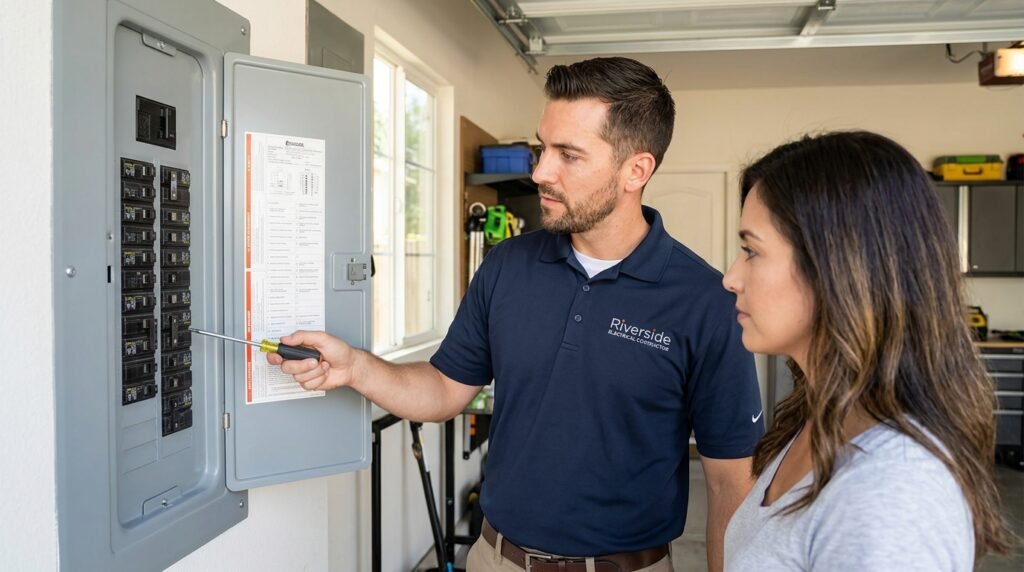
Maybe. Most Level 2 chargers need a dedicated 40 or 50-amp breaker. That’s serious power.
If you have a 100-amp panel that’s already maxed out, you need an upgrade first. If you have a 200-amp panel with spare capacity, you might be okay.
The electrician assesses your panel during the quote. They’ll tell you if an upgrade is needed.
A panel upgrade adds $1,500 to $3,500 to the total cost. It’s worth it. A new panel gives you the capacity for EV charging plus everything else.
Check our guide on panel upgrades in Riverside for more details.
What About 240V Outlet Installation for EV Charging?
Some people want a 240-volt outlet instead of a hardwired charger. That way you can unplug the charger and use the outlet for other things.
240-volt outlets work. But hardwired chargers are safer and more efficient. Most electricians recommend hardwired installation.
If you want an outlet, the cost is similar. Around $800 to $1,500 total. You’ll still need the 240-volt circuit. You’ll still need a permit. You’ll still need inspection.
The main difference is the charger plugs in instead of being hardwired. It’s more flexible. But slightly less convenient.
Which Riverside Neighborhoods Are Best for EV Charging?
EV adoption is strong across Riverside. But some neighborhoods are more EV-friendly than others.
Mission Grove and Canyon Crest have lots of newer homes. Many already have chargers or good panel capacity for installation.
La Sierra and Arlington have older homes. You might need a panel upgrade. But it’s doable.
Orangecrest and Woodcrest are growing. New homes usually come with good electrical infrastructure. Older homes in these areas might need upgrades.
No matter where you live in Riverside, you can install an EV charger. You just need the right electrician.
California EV Incentives and Rebates
California wants people charging at home. The state offers incentives.
Your utility company might offer rebates. Riverside is served by Southern California Edison. Check their website for current EV charging rebates.
California also offers tax credits. The state might rebate part of your installation cost. The federal government offers tax credits too. Up to $30 per 240V outlet installed.
These programs change. Check with SCE and the state for current incentives. A licensed electrician can advise you too.
Why Hire a Licensed Electrician for EV Charger Installation
EV charger installation involves 240-volt power. That’s serious. One mistake can kill someone. Or start a fire.
Licensed electricians know what they’re doing. We’ve trained. We’ve passed exams. We know the codes. We carry insurance.
Unlicensed installers are cheaper. But they cut corners. They don’t pull permits. They don’t schedule inspections. If something goes wrong, you’re liable.
Always hire a licensed electrician in Riverside for EV charger installation. Check their license. Read reviews. Get references. It’s worth it.
How Long Does EV Charger Installation Take in Riverside?
Most installations take one day. The electrician shows up. Runs the circuit. Installs the charger. Done.
Simple installs take 4 to 6 hours. Complex installs take 8 to 10 hours. If you need a panel upgrade first, that’s an extra day or two.
You can use your car again immediately. Start charging that night.
Ready to Install Your Home EV Charger?
If you own an electric car in Riverside, a home charger is one of the best investments you can make. Stop wasting time at public charging stations. Charge at home. Wake up ready to go.
We service all of Riverside. Canyon Crest. Mission Grove. La Sierra. Orangecrest. Woodcrest. Arlington. Wherever you are, we’ll get you charged.
Contact us for a free quote. We’ll assess your setup. Tell you what you need. Give you a clear price. No surprises. We’re licensed. We’re local. And we’re ready to help you charge.
Frequently Asked Questions
How much does it cost to install an EV charger in Riverside, CA?
Installing a Level 2 EV charger in Riverside costs $800 to $2,000 total. The charger unit runs $300 to $800 depending on the model. Electrical work ranges from $400 to $1,200 based on distance from your panel to the garage. The permit costs $50 to $100. Most Riverside homeowners pay around $1,000 to $1,500. If you need a panel upgrade first, add $1,500 to $3,500 to that cost.
Do I need a permit for EV charger installation in Riverside?
Yes. Riverside requires permits for all EV charger installations. The permit costs $50 to $100. A licensed electrician pulls the permit for you. After installation, a city inspector checks the work to make sure it meets electrical code. If it passes, you’re done. Don’t skip the permit. Unpermitted work causes problems when you sell your home. Buyers discover it during inspections and you’ll have to fix it then.
Can I install a Tesla charger on my own in Riverside?
Technically yes, you can buy and install a Tesla charger yourself. But you still need a permit from Riverside. You still need a licensed electrician to run the 240-volt circuit from your panel. And you still need a city inspection. The circuit installation is the hard part. It requires knowledge of electrical code and proper wire sizing. Don’t try this without a license. Hire a professional. It’s safer and it’s done right.
How long does EV charger installation take in Riverside?
Most EV charger installations take one day. The electrician arrives in the morning. Runs the 240-volt circuit from your panel. Mounts the charger. Tests everything. By evening you’re charging. Simple installations take 4 to 6 hours. Complex ones take 8 to 10 hours. If you need a panel upgrade first, that adds an extra day or two.
Do I need to upgrade my panel for an EV charger in Riverside?
Maybe. Most Level 2 chargers need a dedicated 40 or 50-amp breaker. That’s serious power. If you have a 100-amp panel that’s already maxed out, you need an upgrade first. If you have a 200-amp panel with spare capacity, you might be okay. The electrician assesses your panel during the quote. They’ll tell you if an upgrade is needed. A panel upgrade costs $1,500 to $3,500. It’s worth it for safety and future capacity.
What’s the difference between Level 1 and Level 2 EV charging?
Level 1 uses a standard 120-volt outlet. It adds about 2 to 5 miles of range per hour. Charging a dead battery takes 24+ hours. Level 2 uses a 240-volt circuit. It adds about 25 to 30 miles of range per hour. A dead battery charges overnight. Most Riverside homeowners need Level 2. It’s way faster. Costs more to install but worth it. Level 1 only works if you drive short distances.