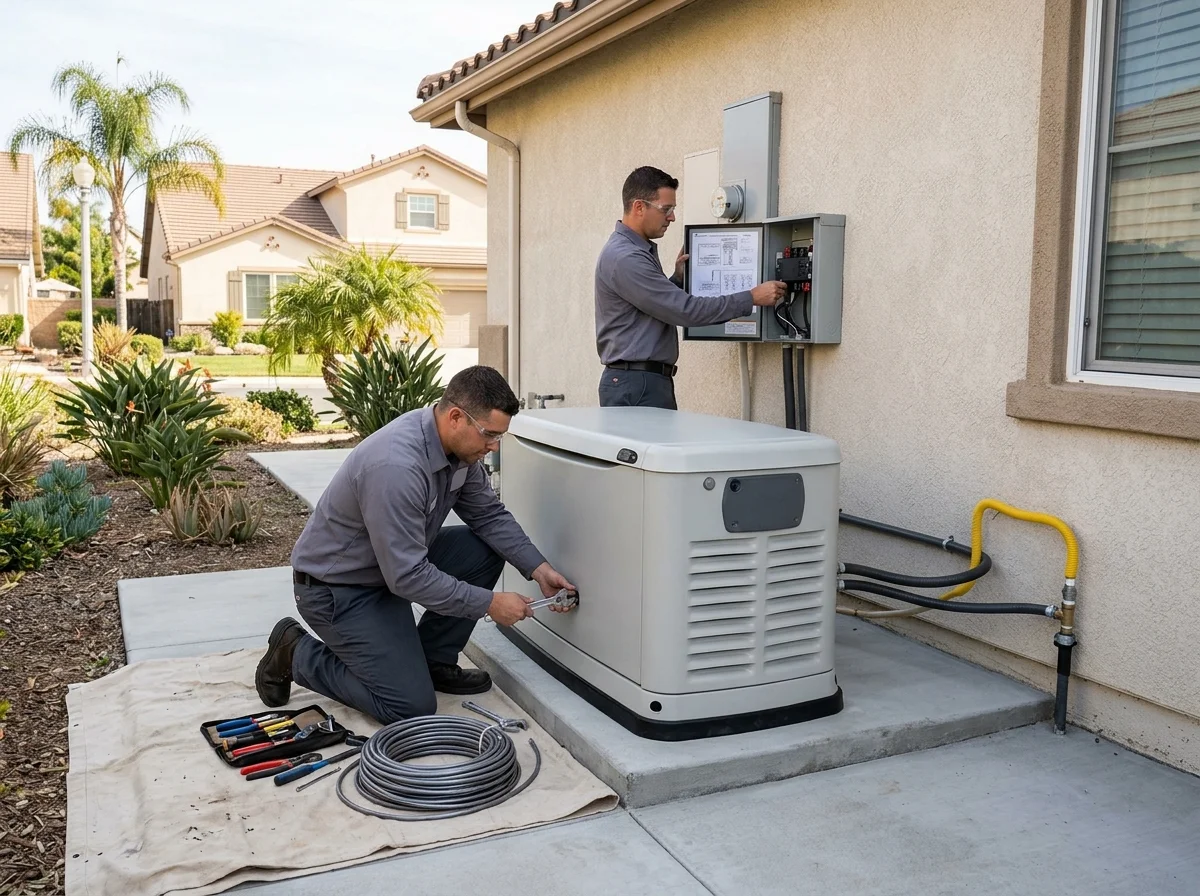
Power outages happen in Riverside. Heat waves. Storms. Grid failures. When the power goes out, life stops. No AC in 110-degree heat. No refrigeration. No lights. No charging devices. It’s miserable. A backup generator fixes this. You keep power running when the grid fails. Your AC keeps running. Your food stays cold. Your home stays livable.
But generators aren’t cheap. And installation isn’t simple. You need the right size. The right fuel source. Proper permits. Correct installation. This guide explains everything Riverside homeowners need to know about generator installation. From cost to how they work to why you need one. Explore our backup generator installation services for help with generator sizing, transfer switches, permits, fuel connections, and professional setup.
What Is a Home Generator?
A home generator is a machine that produces electricity. When the power goes out, it kicks on automatically. It powers your home until the grid comes back.
Generators come in two types. Portable and permanent. Most homeowners need to decide between them.
Portable Generators
Portable generators are smaller. They cost less. Around $500 to $2,000 for a decent one.
But they’re not automatic. When power goes out, you have to:
- Go get the generator
- Set it up outside
- Plug it in
- Start it
- Run extension cords inside
That takes time. And you can’t power your whole house. You pick which things get power. Refrigerator. Lights. Maybe a fan.
Portable generators run on gasoline or propane. You have to store fuel. You have to refuel them. They’re noisy. Not ideal for neighborhoods.
Portable generators work for occasional use. Camping. Job sites. Temporary backup during short outages.
Permanent Standby Generators
Permanent generators are hardwired to your home. When power goes out, they kick on automatically. Usually within seconds.
They power your whole house. AC. Lights. Refrigerator. Everything runs normally.
Permanent generators run on natural gas or propane. If you have natural gas service, the generator pulls from your existing line. No storing fuel. No refueling.
They’re quieter than portable generators. They’re automatic. They’re powerful enough for whole-house backup.
Cost is higher. Usually $3,500 to $7,000 installed in Riverside. But the convenience and peace of mind are worth it.
Why Install a Generator in Riverside?
Riverside has summer power outages. Heat waves stress the grid. Rolling blackouts happen. Air conditioning is essential. When the power goes out, homes become unbearable in minutes.
Here’s why a generator makes sense.
Heat Safety
Riverside gets over 100 degrees regularly. When power goes out, AC stops. Your home becomes dangerous. Especially for kids and elderly people.
A generator keeps AC running. Your home stays cool. Your family stays safe.
Food Safety
No power means no refrigeration. Food spoils. You lose money. You waste food.
A generator keeps your fridge running. Food stays fresh.
Peace of Mind
When you have a generator, you don’t worry about outages. Power goes out? Your generator kicks on. Life continues normally.
Home Value
Buyers love generators. Especially in Riverside where outages are common. A home with backup power is more valuable. It’s a selling point.
Business Continuity
If you work from home, you need power. Laptop. Internet router. Phone chargers. A generator keeps you working.
Whole House Generator vs. Portable Generator
Let’s compare the two options.
Whole House Generator
Cost: $3,500 to $7,000 installed
Power: Runs entire home
Activation: Automatic
Fuel: Natural gas or propane (no storing fuel)
Noise: Quieter (70-80 decibels)
Maintenance: Minimal (annual service)
Convenience: High (automatic)
Installation: Requires permit and professional install
Best for: Permanent backup power. Heat safety. Peace of mind.
Portable Generator
Cost: $500 to $2,000
Power: Selected circuits only
Activation: Manual (you start it)
Fuel: Gasoline or propane (you store fuel)
Noise: Very loud (80-90+ decibels)
Maintenance: Regular (fuel storage, spark plugs)
Convenience: Low (manual operation)
Installation: No permit needed (but extension cords required)
Best for: Occasional use. Camping. Construction sites.
For Riverside homeowners, a whole house generator makes sense. You get automatic backup. Your whole home stays powered. You don’t have to do anything.
Generator Installation Cost in Riverside
Whole house generator installation in Riverside costs $3,500 to $7,000. Here’s the breakdown.
Generator Unit: $1,500 to $3,500
A quality whole house generator costs $1,500 to $3,500. Popular brands like Generac run around $2,000 to $3,000.
Bigger generators cost more. A 10 kW generator costs less than a 20 kW generator. Most homes need 10 to 15 kW.
Installation Labor: $1,000 to $2,500
Running a gas line from your meter to the generator takes time. Mounting the generator. Wiring the transfer switch. Connecting everything to code. All of that takes labor.
Simple installations cost $1,000. Complex installations cost $2,500 or more.
Transfer Switch: $500 to $1,000
A transfer switch is required. It automatically switches between grid power and generator power. Without it, you could backfeed power into the grid. That kills utility workers.
A quality transfer switch costs $500 to $1,000 installed.
Permit and Inspection: $100 to $300
Riverside requires permits for generator installation. The permit fee is cheap. Usually $100 to $200. City inspection is included.
Total Cost: $3,500 to $7,000
For most Riverside homes, expect to pay $4,000 to $5,500 for a quality whole house generator system installed.
That’s a one-time investment. Then you have backup power for life.
How Do Generators Work?
A generator produces electricity using an engine. The engine burns fuel. The spinning motion creates electrical current. That current powers your home.
Natural Gas Generators
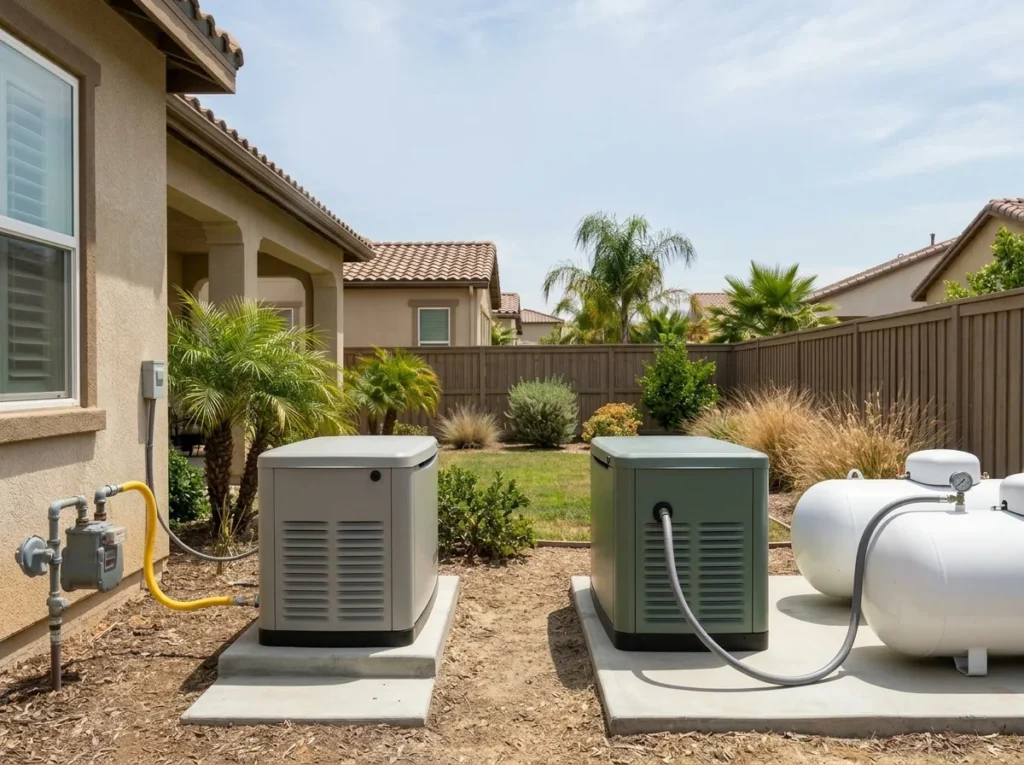
Natural gas generators pull fuel from your existing gas line. They’re connected directly to your meter.
When power goes out, the generator automatically switches on. It pulls gas from your line. Burns it. Creates electricity. Runs your home.
When power comes back, the generator automatically shuts off.
No storing fuel. No refueling. Just automatic backup power.
Propane Generators
Propane generators use a propane tank. Similar to a generator on a construction site. But bigger and permanently installed.
When power goes out, the generator kicks on. Burns propane from the tank. Creates electricity. Runs your home.
The tank needs refilling periodically. Usually once per year if you don’t use it much. If you use it during frequent outages, you refuel more often.
Natural gas is more convenient. Propane requires tank management.
Sizing Your Generator for Riverside
Picking the right size generator is important. Too small and it won’t power everything. Too big and you waste money.
Most Riverside homes need 10 to 15 kW generators.
A 10 kW generator can power:
- AC (if sized properly)
- Fridge and freezer
- Water heater
- Washer and dryer
- Lights throughout the home
- Most appliances
A 15 kW generator can power everything without restrictions. Multiple AC units. Multiple large appliances running simultaneously.
An electrician assesses your home. Looks at your panel. Calculates your needs. Recommends the right size.
Don’t guess. Get a professional assessment.
Natural Gas vs. Propane Generators in Riverside
Both work. The difference is fuel source.
Natural Gas Generators
Pros:
- Unlimited fuel (connected to your gas line)
- No storing fuel
- No refilling
- Cleaner burning
- More convenient
Cons:
- Dependent on natural gas service
- If gas line fails, generator won’t run
- Slightly more expensive upfront
Best for: Homes with natural gas service. Most Riverside homes have gas.
Propane Generators
Pros:
- Works without natural gas service
- Works if gas line fails
- Propane stores indefinitely
Cons:
- Need to store propane tank
- Need to refill tank periodically
- Tank takes up space
- More hassle
Best for: Homes without natural gas. Rural areas. As backup if natural gas fails.
For most Riverside homes, natural gas generators make sense. You already have gas service. The generator hooks into your existing line. Automatic and hassle-free.
Generator Installation Process in Riverside
Here’s what happens step by step.
1. Assessment and Sizing
An electrician visits your home. Looks at your electrical panel. Understands your power needs. Recommends the right generator size.
They also assess your location. Where will the generator go? Is there a good spot? Is there access to gas or propane?
2. Permit Application
The electrician applies for a permit from Riverside. Includes generator specs. Installation plans. Location details.
The permit costs $100 to $200. Takes a few days to approve.
3. Preparation
Your electrician prepares your home. Clears space for the generator. Plans the gas line run. Plans the electrical connections.
4. Generator Installation
The generator is delivered and installed. Usually mounted on a concrete pad outside your home. Or sometimes in a garage or utility room.
The unit is secured. Fuel line is connected. Electrical connections are made. Transfer switch is installed.
This takes a full day usually.
5. Testing
Once everything is connected, the electrician tests the system. Makes sure the generator kicks on properly. Makes sure power switches correctly. Makes sure everything works.
6. City Inspection
A city inspector visits. Checks the installation. Makes sure it meets code. Verifies the transfer switch. Checks gas line connections. Makes sure everything is safe.
Most installations pass first time.
7. Final Sign-Off
Once inspection passes, you’re done. The permit is closed. Your generator is officially installed and inspected.
You now have backup power.
Where Should You Place Your Generator in Riverside?
Generator placement matters. Here are the options.
Outside (Concrete Pad)
Most generators are placed on a concrete pad outside. Usually on the side of the house or in the backyard.
Pros: Easy access for service. Doesn’t take up indoor space. Easy gas line connection.
Cons: Exposed to weather. Takes up yard space. Noise travels.
Garage
Some homeowners put generators in the garage. Keeps it sheltered. Hidden from view.
Pros: Sheltered from weather. Space efficient. Out of sight.
Cons: Takes up garage space. Gas line has to run through the house. Exhaust needs venting.
Utility Room
Some put them in a utility room or shed. Keeps them dry and hidden.
Pros: Protected. Out of view. Compact.
Cons: Takes up indoor space. Requires venting. Gas line installation more complex.
An electrician advises on the best location for your specific situation.
Riverside Power Outages: Why a Generator Makes Sense
Riverside has regular power outages. Here’s why.
Summer Heat Waves
Summer temperatures hit 110+ degrees regularly. Peak power demand stresses the grid. Rolling blackouts happen. Sometimes they last hours.
Your AC is essential. A generator keeps it running.
Aging Infrastructure
Some areas of Riverside have aging power infrastructure. Equipment fails. Outages result.
Maintenance and Upgrades
Southern California Edison does maintenance work. Sometimes they shut off power for hours.
A generator keeps you powered through maintenance windows.
Weather Events
Occasional storms knock out power. Usually temporary. But uncomfortable.
A generator gets you through quickly.
Grid Instability
The grid is increasingly stressed. More people. More demand. More outages.
A generator gives you independence from grid problems.
Generator Maintenance in Riverside
A generator needs minimal maintenance. But some care is required.
Annual Service
Have your generator serviced annually. The electrician checks the engine. Tests the transfer switch. Makes sure everything works.
Annual service costs $150 to $300. It keeps your generator in top shape.
Monthly Exercise
Some recommend running your generator monthly. Keeps the engine healthy. Makes sure fuel flows properly.
Just run it for 10 minutes once a month. That’s enough.
Fuel Stability
If you have a propane generator, check the tank occasionally. Make sure fuel is available. Refill as needed.
Natural gas generators don’t have fuel concerns. Gas comes through the line.
Cleanliness
Keep the area around your generator clean. Remove leaves and debris. Make sure vents are clear.
Proper airflow keeps the generator cool.
Generator Installation Permits in Riverside
Riverside requires permits for generator installation. The permit process is straightforward.
- Licensed electrician pulls permit
- City reviews plans
- Electrician installs generator
- City inspector checks everything
- Permit is closed
The permit fee is around $100 to $200. The process takes about a week.
Check our guide on electrical permits in Riverside for more details.
Why Hire a Licensed Electrician for Generator Installation
Generator installation involves natural gas lines. Electrical work. Transfer switches. Complex systems. One mistake and the whole thing fails. Or worse, causes a fire.
Licensed electricians know generator installation. We’ve trained. We’ve done hundreds of installs. We know the code. We follow it.
Unlicensed installers cut corners. They don’t pull permits. They don’t schedule inspections. They do sloppy work.
Always hire a licensed electrician in Riverside for generator installation. Check their license. Read reviews. Get references.
How Long Does Generator Installation Take?
Most installations take one day. The electrician arrives in the morning. Installs the generator. Tests everything. By evening you have backup power.
Complex installations might take two days. If gas line runs are long. If electrical work is extensive.
But most installs finish in a single day.
Can You Use a Portable Generator While Your Whole House Generator Is Installed?
Yes. If you’re waiting for a whole house generator to be installed, a portable generator works temporarily.
You can use a portable generator to power essential circuits. Fridge. Some lights. A fan.
Just don’t plug it into a wall outlet. That can damage the generator. Use heavy-duty extension cords from the portable generator directly to what you need to power.
And never run a portable generator indoors. Carbon monoxide kills. Always run them outside.
Ready to Install a Backup Generator in Riverside?
Power outages are inevitable in Riverside. Heat waves. Grid stress. Equipment failure. When power goes out, a generator keeps your home running.
Don’t wait for an outage. Install a generator now. Then when power fails, you’re protected.
We install generators all across Riverside. Canyon Crest. Mission Grove. La Sierra. Orangecrest. Woodcrest. Arlington. Wherever you are, we can install a generator.
Contact us for a free assessment. We’ll size the generator. Give you a clear price. Handle the permit. Install and test everything. We’re licensed. We’re local. And we’re ready to keep your power on.
Frequently Asked Questions
How much does a whole house generator cost in Riverside, CA?
A whole house generator in Riverside costs $3,500 to $7,000 installed. The generator unit runs $1,500 to $3,500. Installation labor is $1,000 to $2,500. The transfer switch costs $500 to $1,000. Permit and inspection add $100 to $300. Most Riverside homeowners pay $4,000 to $5,500 total. That’s a one-time investment for lifetime backup power.
What size generator do I need for my Riverside home?
Most Riverside homes need a 10 to 15 kW generator. A 10 kW generator powers AC, lights, appliances, and most circuits. A 15 kW generator powers everything without restriction. An electrician assesses your home. Looks at your panel. Calculates your needs. They recommend the right size. Don’t guess. Get a professional assessment.
Do I need a permit for generator installation in Riverside?
Yes. Riverside requires permits for all generator installations. The permit costs $100 to $200. A licensed electrician pulls the permit for you. After installation, a city inspector checks everything. If it passes, you’re done. Don’t skip the permit. Unpermitted work causes problems when you sell your home.
How long does generator installation take in Riverside?
Most installations take one day. The electrician installs the generator. Wires the transfer switch. Tests everything. By evening you have backup power. Complex installations might take two days. But most finish in a single day.
Should I get a natural gas or propane generator for my Riverside home?
Natural gas is better for most Riverside homes. Your generator connects to your existing gas line. Unlimited fuel. No storing or refilling tanks. Completely automatic. Propane requires a tank. You have to refill it periodically. More hassle. Unless you don’t have natural gas service, go with natural gas.
How often does a generator need maintenance in Riverside?
Annual service is recommended. An electrician services the generator. Checks the engine. Tests the transfer switch. Makes sure everything works. Annual service costs $150 to $300. Keep your generator in top shape. Also run it monthly for 10 minutes. Keeps the engine healthy.
What’s the difference between a portable and whole house generator?
Portable generators are small. Cost $500 to $2,000. Manual operation. You start them. You pick what to power. Noisy. Require fuel storage. Good for occasional use or camping. Whole house generators are permanent. Cost $3,500 to $7,000. Automatic operation. Power your entire home. Natural gas fuel source. Quieter. Best for Riverside homes where outages are common.