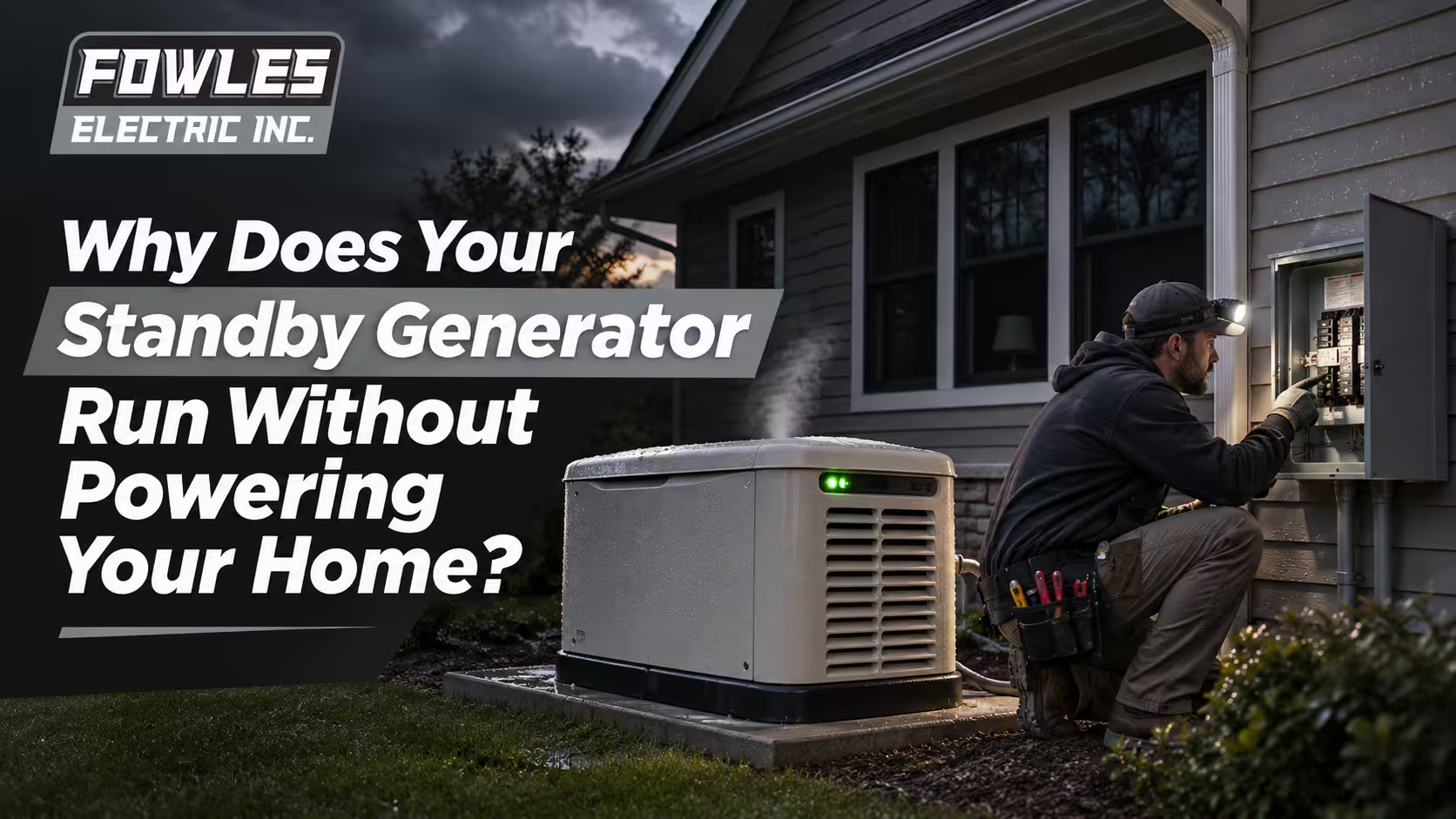
A standby generator may start during an outage and run smoothly while every room stays dark. The engine is operating, but electricity may not be reaching your home. The fault may involve generator output, the automatic transfer switch, or connections to the electrical panel.
A standby power system must detect utility failure, start the engine, produce acceptable voltage, and transfer the load. If one stage fails, the generator runs without supplying electricity.
How the Automatic Transfer Switch Delivers Power
The automatic transfer switch (ATS) connects backed-up circuits to utility or generator power. During an outage, it detects utility failure, signals the generator to start, and transfers the load once generator output is acceptable.
As soon as utility power becomes available again, the ATS reconnects the house to the main supply. If it fails to transfer during an outage, the engine may run while the home remains disconnected.
Common Reasons a Generator Runs but Does Not Power the House
Several faults can interrupt the path between the generator and electrical panel.
| Possible fault | How it interrupts power |
| Generator circuit breaker is open or tripped | Generator output cannot reach the transfer switch |
| Automatic transfer switch failure | The switch does not connect the home to generator power |
| Control or sensing fault | The system does not detect utility loss or complete the transfer command |
| Generator output problem | The alternator or voltage regulator does not produce usable power |
| Wiring or contact failure | A damaged connection, fuse, relay, or contact blocks electricity |
1. The Generator Circuit Breaker Is Off or Tripped
A primary circuit breaker safeguards the generator’s electrical output. If it is off or trips, the engine may keep running while power cannot reach the transfer switch. Overloads, short circuits, and other electrical faults can trigger a breaker. Never reset it repeatedly if it continues to trip.
2. The Automatic Transfer Switch Does Not Move
Damaged contacts, a faulty relay, a mechanical problem, or an internal control fault can stop the ATS from connecting generator power to the home. Burned or stuck contacts may prevent transfer or cause inconsistent power. Because the enclosure contains potentially live parts, inspection and repair require a qualified professional.
3. Utility Power Detection or Control Logic Fails
The generator control module and ATS coordinate transfer through sensing and control circuits. A wiring fault, blown fuse, loose connection, or failed control board can interrupt communication. The generator may receive a start command but not the signal to transfer the load. These faults require model-specific testing.
4. The Generator Runs Without Producing Usable Output
A running engine does not guarantee correct output voltage. An alternator fault, voltage regulator problem, or damaged wiring can leave output low, unstable, or absent. A technician checks voltage and frequency against manufacturer specifications. Homeowners should not remove covers or test energized terminals.
5. A Connection or Distribution Fault Blocks Power
Loose conductors, failed fuses, faulty contacts, or panel problems can interrupt backup power distribution. Neutral and grounding configuration issues may also affect safe operation. If only some circuits are off, a branch breaker, backup circuit arrangement, or overload may be responsible.
What Homeowners Can Safely Check First
Limit checks to visible indicators and normal homeowner controls. Never open enclosures, touch wiring, or move internal switch mechanisms.
- Read the generator display: Note any warning light, fault indicator, or error code. Record the exact message.
- Check the operating mode: Use the normal external controls and owner’s manual to confirm the unit has not been placed in OFF mode.
- Observe the breaker position: If it appears off or tripped, do not force it back on. Contact a generator service professional.
- Identify affected circuits: Note whether the whole house is dark or only selected rooms and appliances are affected.
- Watch and listen from a safe distance: Note unusual sounds, visible damage, smoke, or fuel odor. Move away and seek emergency help if there is an immediate hazard.
Do not manually override an ATS unless the manufacturer’s instructions permit it and a qualified technician confirms it is safe. Incorrect operation can expose you to dangerous voltage or create a utility backfeed hazard.
How a Technician Diagnoses the Problem
A professional traces the power path from the generator to the home, checking output voltage and frequency, breaker condition, control signals, transfer switch operation, and connections. The technician may test the alternator, voltage regulator, relays, fuses, and contacts.
This separates an output problem from an ATS failure or distribution fault. The technician may also review battery condition, air filters, oil and filters, fuel supply, and maintenance records. These affect reliability but are not automatically the cause of every transfer failure.
When to Arrange Generator Repair
Arrange service if the generator runs but the home receives no power, a breaker repeatedly trips, the transfer switch makes unusual noises, or the control panel displays a fault.
In Redlands, an electrical professional can assess the generator, transfer switch, and home distribution equipment together. Fowles Electric Inc can identify whether the fault involves output, control logic, or transfer equipment.
Frequently Asked Questions
Why is my generator running but not powering my house?
The output breaker may be open, the transfer switch may have failed, or a control or electrical fault may be blocking power. Professional testing identifies the cause.
Can an automatic transfer switch stop a generator from powering my home?
Yes. If the ATS cannot detect the outage, receive the required signal, or connect the generator source, electricity may not reach the home.
Should I reset the generator breaker myself?
Do not repeatedly reset a tripped breaker. Follow the owner’s manual for normal external checks and arrange service if the breaker is off, trips again, or the cause is unclear.
Why Is My Generator Powering Only Certain Areas of the House?
Some systems supply selected backup circuits, not every circuit. If expected circuits remain off, a branch breaker, load distribution issue, transfer switch fault, or damaged connection may be responsible.
Final Thoughts: Restore the Complete Backup Power System
A standby generator is useful only when its engine, electrical output, controls, transfer switch, and distribution connections work together. If it runs but your home stays dark, avoid risky DIY electrical checks and have the complete power path inspected. Fowles Electric Inc can help locate the fault and restore dependable backup power.