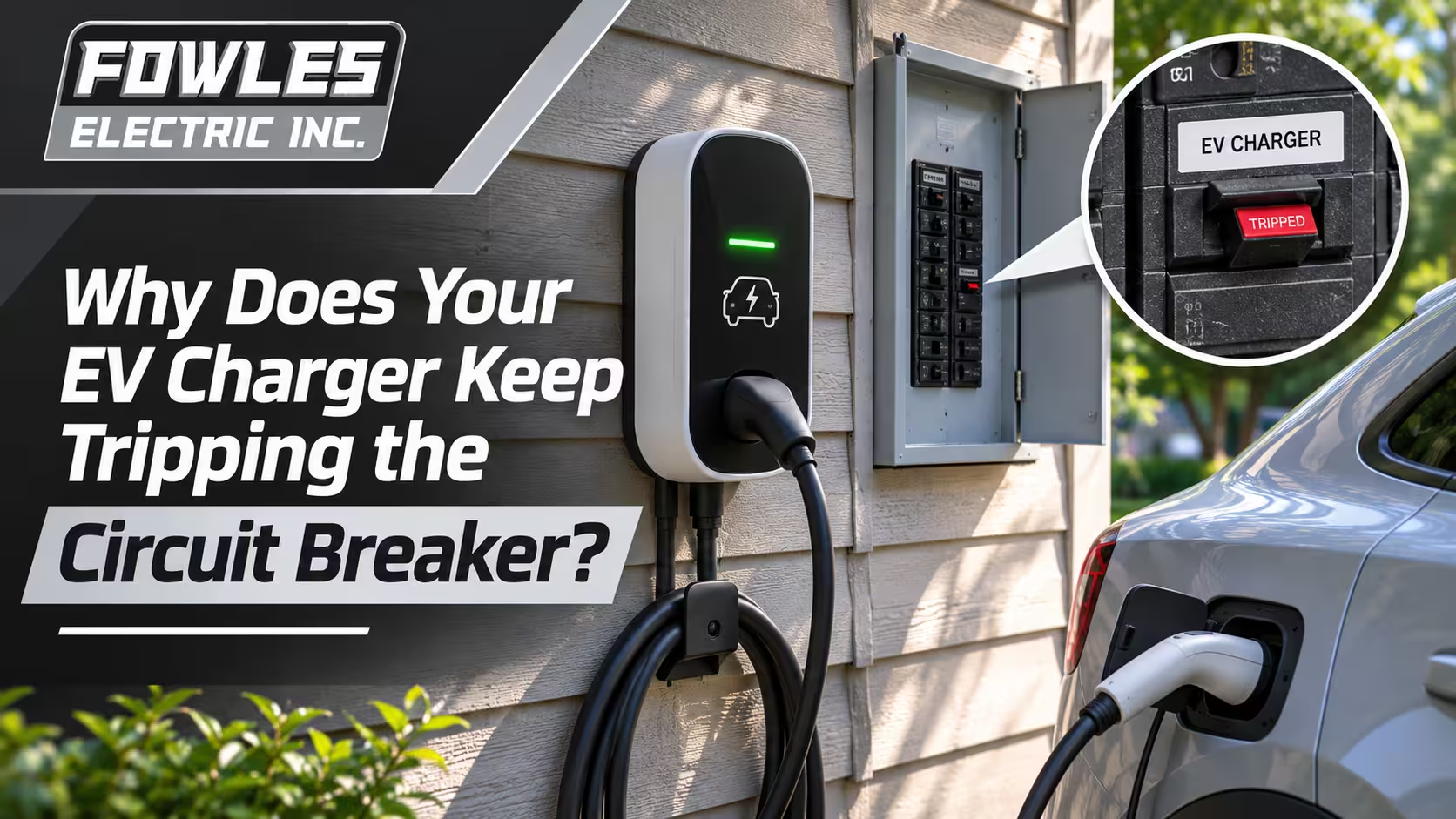
You plug in your electric vehicle after dinner, expecting an overnight charge. Instead, the session stops and the breaker trips. It may happen within seconds or after half an hour. Timing offers clues, but it does not identify the fault by itself.
A Level 2 charger draws steady power for hours. That sustained demand can expose problems with circuit sizing, current settings, wiring connections, ground-fault protection, or the equipment itself. Knowing the difference between a breaker trip and a charger error helps prevent guesswork.
First, Confirm What Actually Stopped
A breaker trip differs from an EVSE or vehicle fault notification. When a breaker trips, it disconnects power to the affected circuit and stops electricity from flowing. If it remains on but the charger displays an error, the issue may involve the vehicle, cable, connector, or EVSE controls.
Do not repeatedly reset a tripped breaker. Stop using the charger and arrange an inspection if the interruption happens more than once.
What the Timing of a Trip May Tell You
The pattern can help narrow down the investigation.
| When charging stops | Possible explanation to investigate |
| Immediately after starting | Short circuit, ground fault, wiring error, or equipment fault |
| After 10–30 minutes | Heat building at a loose connection, overloaded circuit, or weak breaker |
| Only at a higher current setting | Charging demand may exceed the circuit’s suitable capacity |
| When another appliance runs | Shared circuit or overall electrical load may be a factor |
| With one vehicle or charger only | Vehicle, cable, connector, or EVSE compatibility issue |
These are clues, not diagnoses. A delayed trip does not automatically mean the breaker is defective.
Six Common Causes of EV Charger Breaker Trips
1. Charging current is set too high
The charger may be set to draw more current than the branch circuit can safely supply. Set adjustable current only according to the circuit design and manufacturer instructions.
2. The circuit is not sized for a continuous load
EV charging is a continuous load. Under the 125% sizing rule, a 32-amp load typically requires a 40-amp branch circuit; a 40-amp load typically requires 50 amps. The design must also account for conductor ampacity, installation conditions, terminals, and equipment listings.
| EV charging current | Typical minimum circuit rating at 125% |
| 16 amps | 20 amps |
| 24 amps | 30 amps |
| 32 amps | 40 amps |
| 40 amps | 50 amps |
| 48 amps | 60 amps |
These are examples, not instructions to change a breaker. An electrician must confirm the entire circuit is suitable.
3. A connection is loose or overheating
A loose terminal, worn receptacle, or damaged conductor can create resistance and heat. That heat may build until the breaker or another protective device interrupts power.
4. Another appliance is sharing the circuit
A properly installed EVSE should operate on an individual branch circuit reserved exclusively for charging. If it shares a circuit with a freezer or workshop equipment, combined demand may contribute to interruptions. An electrician can check the wiring and service load calculation.
5. Ground-fault protection detects a problem
Moisture, damaged insulation, a compromised cable, or an internal fault can cause leakage current. Ground-fault protection reduces shock risk; never bypass it.
6. The breaker or charging equipment has a fault
Breakers can wear out, but replacing one without testing may leave the real problem unresolved. A faulty EVSE, cable, connector, or vehicle system can also interrupt charging. The supply may need testing separately.
A Practical Example: Why a Trip Happens Later
Imagine a homeowner charging at 40 amps on a circuit not designed for that demand. A weak connection warms as current flows, and the breaker trips after several minutes. Lowering current may change the symptom, but it does not repair the connection or make unsuitable wiring safe.
Warning Signs: Stop Using the Charger
Stop charging immediately if you notice any of these warning signs:
- A burning or hot-plastic smell near the panel, outlet, cable, or charger.
- Crackling, buzzing, visible discoloration, or melted plug material.
- A breaker or receptacle that feels unusually warm.
- Repeated trips, even after the charger has cooled.
- A damaged cable, loose connector, or visible moisture inside electrical equipment.
Keep clear and contact a qualified electrician. If there is smoke or fire, move away and call emergency services.
What Should You Do Before Calling an Electrician?
Collect useful information without opening the panel or handling wiring:
- Note whether the breaker trips or the charger simply displays an error.
- Record how long charging runs before the interruption.
- Write down the charger model and selected amperage.
- Note whether the problem occurs with another vehicle or charging cable, if the manufacturer permits that check.
- Photograph any error message and share it with the electrician.
Do not remove panel covers, tighten terminals, replace breakers, or increase the breaker rating yourself.
Redlands, CA: Local Electrical Requirements
Redlands has adopted the 2025 California Electrical Code. Municipal Code Section 15.58.040 treats EV charging equipment as a continuous load and requires it in electrical load calculations for new or existing services. The city provides an EV charging permit checklist through Building and Safety.
This means an electrician must consider the charger, branch circuit, and available service capacity together. Fowles Electric Inc can inspect the circuit, connections, protective devices, and charger settings.
Frequently Asked Questions
Why does my EV charger trip the breaker after 10 minutes?
A delayed trip may occur as wiring, terminals, or a breaker heats up under sustained current. It can also indicate an overloaded circuit. An inspection is needed to identify the cause.
Does a tripped breaker mean the EV charger is defective?
No. The breaker, circuit conductors, connections, ground-fault protection, charger, or vehicle may be involved. Electrical testing can help determine whether the problem comes from the power supply or the charging equipment itself.
Should I lower the charger amperage or replace the breaker?
Do not replace the breaker or raise its rating without an electrical assessment. A lower current setting may be appropriate only after the circuit and manufacturer instructions are checked.
Does Installing a Level 2 EV Charger Require Its Own Dedicated Circuit?
EV charging equipment typically requires a separate branch circuit reserved exclusively for its operation. The exact design and any permitted exceptions should be confirmed against the applicable code and equipment instructions.
Final Thoughts: Do Not Ignore Repeated EV Charging Trips
Repeated breaker trips signal a problem that needs attention. The cause may be an incorrect current setting, circuit-capacity issue, loose connection, ground-fault protection, or faulty equipment. Guesswork and repeated resets can increase the risk.
Fowles Electric Inc can help Redlands homeowners identify the source of charging interruptions. Ask a qualified electrician to inspect the circuit before using the charger again.